1
/
of
1
AV8 ACE
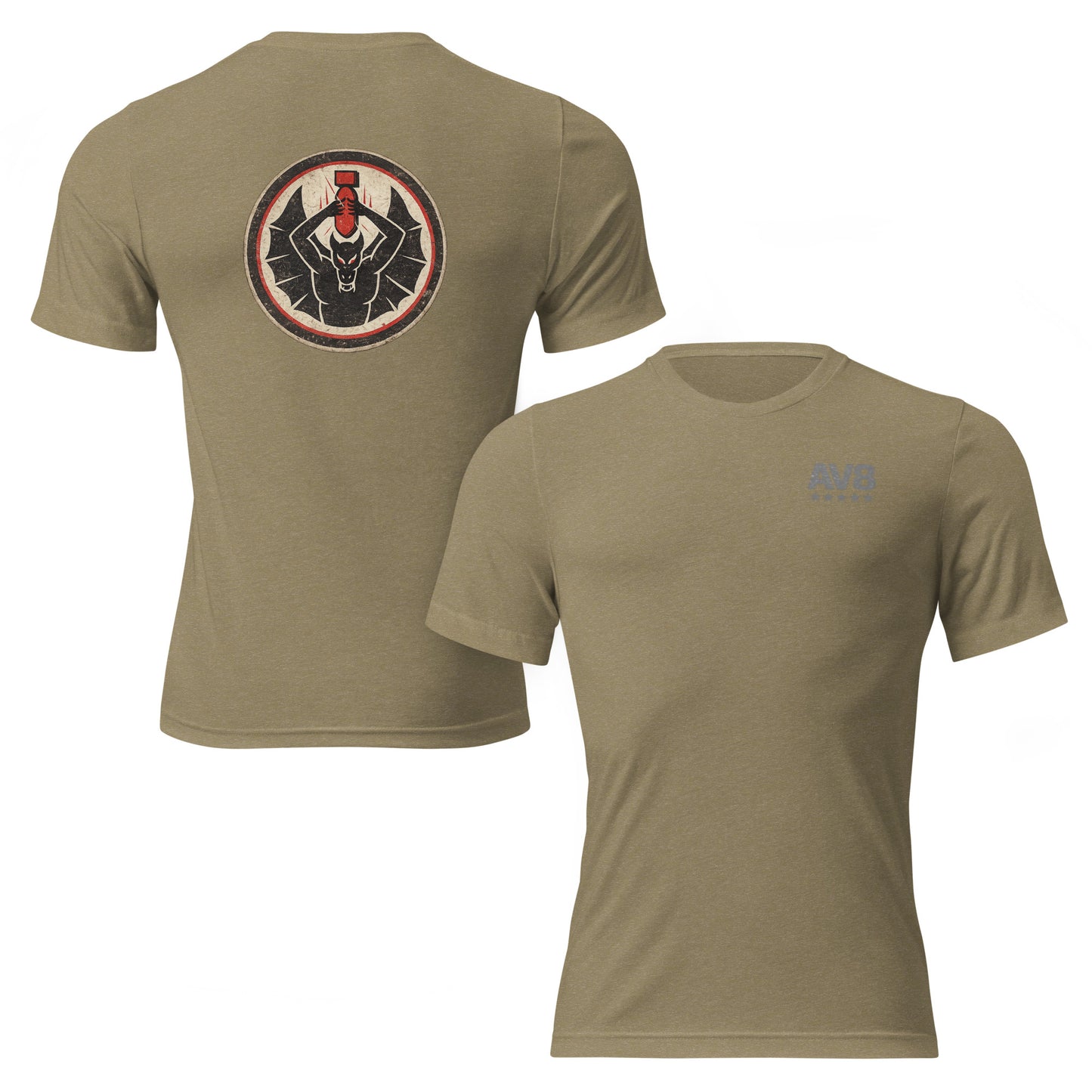
AV8 Ace 650th Bomber Squadron Tee
AV8 Ace 650th Bomber Squadron Tee
Regular price
$32.00 USD
Regular price
Sale price
$32.00 USD
Quantity
Couldn't load pickup availability
The 650th Bombardment Squadron (Light) was activated on 1 August 1943 as one of four squadrons—the 648th, 649th, 650th, and 651st—assigned to the 411th Bombardment Group. Initially organized at Will Rogers Field, Oklahoma, the group soon transferred to Florence Army Air Field, South Carolina, where it absorbed experienced personnel from the 65th Reconnaissance Group. Unlike many bombardment squadrons created during World War II, the 650th was not intended primarily for overseas combat. Its mission was equally important to the expanding U.S. Army Air Forces: preparing replacement bomber crews for deployment to operational combat units around the world.
The 650th trained primarily with the Douglas A-20 Havoc, a fast, twin-engine light attack bomber widely employed by American and Allied forces for low-level bombing, strafing, interdiction, and ground-support missions. As part of a Replacement Training Unit (RTU), the squadron helped transform newly trained pilots, navigators, bombardiers, gunners, and other aircrew members into combat-ready crews. Training emphasized formation flying, navigation, bombing, aerial gunnery, night and cross-country operations, and the coordination necessary to operate effectively as a bomber crew. Once their training was completed, these airmen left the 650th for replacement pools and operational organizations, where many would ultimately participate in combat overseas. The 411th also inherited personnel familiar with the North American B-25 Mitchell, but the group's designated replacement-training aircraft was the A-20 Havoc.
The 650th's existence was relatively brief, but that short service reflects the enormous training organization required to sustain America's wartime air offensive. By 1944, the Army Air Forces determined that traditional combat-group organizations were too rigid for the replacement-training mission and began reorganizing training bases into standardized Army Air Forces Base Units. Consequently, the 411th Bombardment Group and its 650th Bombardment Squadron were disbanded on 1 May 1944, with their personnel, aircraft, equipment, and training responsibilities transferred to the 334th Army Air Forces Base Unit (Replacement Training Unit, Light Bombardment). Although the 650th did not build its history through combat missions over enemy territory, its contribution was made by preparing the bomber crews who did—a vital but often overlooked part of the massive American air effort that helped sustain Allied operations during World War II.
The tri-blend fabric creates a vintage, fitted look. And extreme durability makes this t-shirt withstand repeated washings and still remain super comfortable.
• 50% polyester, 25% combed ring-spun cotton, 25% rayon
• Fabric weight: 3.4 oz/yd² (115.3 g/m²)
• Pre-shrunk for extra durability
• 40 singles
• Regular fit
• Side-seamed construction
• Blank product sourced from Guatemala, Nicaragua, Honduras, or the US
Disclaimer: The fabric is slightly sheer and may appear see-through, especially in lighter colors or under certain lighting conditions.
The 650th trained primarily with the Douglas A-20 Havoc, a fast, twin-engine light attack bomber widely employed by American and Allied forces for low-level bombing, strafing, interdiction, and ground-support missions. As part of a Replacement Training Unit (RTU), the squadron helped transform newly trained pilots, navigators, bombardiers, gunners, and other aircrew members into combat-ready crews. Training emphasized formation flying, navigation, bombing, aerial gunnery, night and cross-country operations, and the coordination necessary to operate effectively as a bomber crew. Once their training was completed, these airmen left the 650th for replacement pools and operational organizations, where many would ultimately participate in combat overseas. The 411th also inherited personnel familiar with the North American B-25 Mitchell, but the group's designated replacement-training aircraft was the A-20 Havoc.
The 650th's existence was relatively brief, but that short service reflects the enormous training organization required to sustain America's wartime air offensive. By 1944, the Army Air Forces determined that traditional combat-group organizations were too rigid for the replacement-training mission and began reorganizing training bases into standardized Army Air Forces Base Units. Consequently, the 411th Bombardment Group and its 650th Bombardment Squadron were disbanded on 1 May 1944, with their personnel, aircraft, equipment, and training responsibilities transferred to the 334th Army Air Forces Base Unit (Replacement Training Unit, Light Bombardment). Although the 650th did not build its history through combat missions over enemy territory, its contribution was made by preparing the bomber crews who did—a vital but often overlooked part of the massive American air effort that helped sustain Allied operations during World War II.
The tri-blend fabric creates a vintage, fitted look. And extreme durability makes this t-shirt withstand repeated washings and still remain super comfortable.
• 50% polyester, 25% combed ring-spun cotton, 25% rayon
• Fabric weight: 3.4 oz/yd² (115.3 g/m²)
• Pre-shrunk for extra durability
• 40 singles
• Regular fit
• Side-seamed construction
• Blank product sourced from Guatemala, Nicaragua, Honduras, or the US
Disclaimer: The fabric is slightly sheer and may appear see-through, especially in lighter colors or under certain lighting conditions.
Share